
‘Women in the American Founding’
Expanding the story of the Revolutionary Era
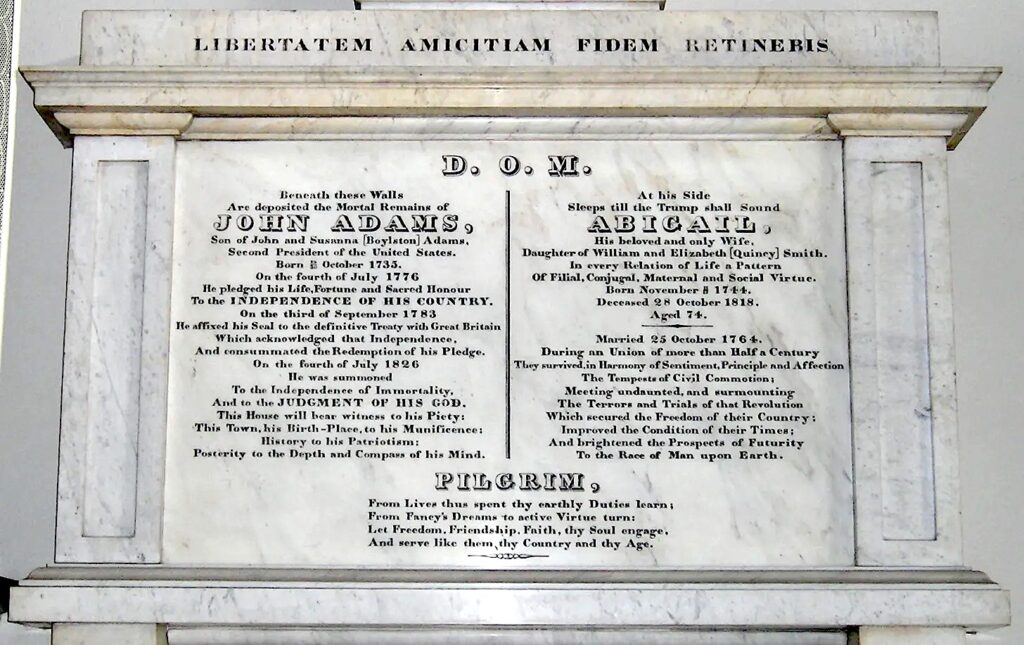
This marker, pictured on Oct. 10, 2017, is in the sanctuary of United First Parish Church in Quincy, Massachusetts, where John Adams, Abigail Adams, John Quincy Adams, and Louisa Adams are all entombed in a basement crypt. PHOTO BY JEFF MORRISON
AMES — Women played essential roles in colonial America and the Revolutionary War, but their contributions often went under-recognized — and unpaid.
That was the lesson of “Women in the American Founding,” an hourlong lecture by Karen Kedrowski on March 3 at the Iowa State University Memorial Union. It was co-sponsored by the Center for Cyclone Civics, Carrie Chapman Catt Center for Women and Politics, the university’s history and political science departments, and the Committee on Lectures. Kedrowski is director of the Catt Center and a political science professor at ISU.
Kedrowski’s focus was mostly on the era just before and during the Revolution, but some historical background was necessary, including that of non-white women. She talked about the Iroquois Confederacy, where the men were the chiefs, but a “council of mothers” named (and sometimes deposed) those chiefs. In addition, no major decisions could be made without ratification by the council. Indentured women, who eventually earned their freedom, and slaves, who could not, were also living in colonial America.
“The single best predictor of whether a European colony would survive was the proportion of women,” Kedrowski said. White women in the Colonies were subject to British “coverture” laws, which put the man in charge of the entire family. Married women could not own property in their own name, and once remarried, the husbands were in charge.
So it’s by extreme circumstance that Eliza Pinckney was able to do what she did. Pinckney, the daughter of a colonial official — not one of the 13 Colonies, but the island of Antigua — was educated in London. Her family moved to Charleston, South Carolina, but her father returned to Antigua, and she was put in charge of three plantations at the age of 16. She spent a decade trying to cultivate indigo, and succeeded. Indigo became a cash crop in South Carolina because of her.
Eliza married Charles Pinckney, a man more than 20 years her senior, and had four children with him. One of them, Charles Cotesworth Pinckney, would go on to be a delegate at the Constitutional Convention. When Eliza’s husband died, she again was in charge of the plantations.
At the other end of the Colonies, in Boston, was Phillis (or Phyllis) Wheatley. She was named for the ship that brought her to North America as a slave and the family that bought her. The family “recognized her genius early,” Kedrowski said, and so Wheatley was educated and wrote poetry.
Wheatley “had a number of her volumes printed, volumes of poetry, and became quite famous as a poet in London, and they were coming back over on a particular ship to Boston, and this was her livelihood, right? She was going to sell these books to support herself and her family. And the books happened to be on the same ship as a particular load of tea.” Wheatley had to scramble to make sure her books weren’t thrown overboard during the Boston Tea Party.
Kedrowski covered many more women of the Revolutionary Era:
-Mary Katherine Goddard of Baltimore owned a printing press and supported the revolutionary cause. When she printed copies of the Declaration of Independence in 1777 complete with the signers’ names, she placed her own name at the bottom of the page.
-Mercy Otis Warren was a satirist, playwright, and historian in Massachusetts. Congress trusted her with writing the first history book about the Revolution. She kept writing plays even though theatrical performances were banned at the time.
-Kitty Greene, wife of Gen. Nathanael Greene, spent the winter of 1777-78 with the Continental Army at Valley Forge and Morristown. She had a “vivacious” personality and, along with Martha Washington, contributed to furnishing morale, supplies, and entertainment for the men.
-Mary Hays, at the Battle of Monmouth in New Jersey, took her husband’s place after he was injured and loaded the cannon herself.
-Margaret Coven put herself in a similar role at the Battle of Fort Washington in the northern part of the island of Manhattan. She was wounded in battle, petitioned to Congress to receive full military recognition, and today is the only Revolutionary-era veteran buried at West Point.
-The ladies of Philadelphia raised $300,000 to buy linen to make 2,200 shirts for the American troops. Women in New Jersey copied the idea. An economic boycott of European clothes made “homespun” clothing the fashion trend, and when soldiers received the shirts, they could find the name of the woman who made each one embroidered on the collar.
-During the entire war, “camp followers,” including the wives and children of soldiers, followed the armies. “They collected wood. They collected water. They fixed food. They mended clothing,” Kedrowski said.
Then there’s Abigail Adams, wife of a future president and mother of another. “By all accounts, including John Adams’ own admission, Abigail Adams was brilliant,” Kedrowski said. With John away for significant amounts of time in Philadelphia and Europe, it was up to her to manage his affairs at their home in Braintree, Massachusetts. Although she was the one making the decisions, as a woman she could not enter into contracts, meaning everything was conducted in John’s name.
Abigail’s famous letter to John in 1776, Kedrowski said, is the “first recorded instance of women demanding any sort of legal rights in America”:
I desire you would Remember the Ladies, and be more generous and favourable to them than your ancestors. Do not put such unlimited power into the hands of the Husbands. Remember all Men would be tyrants if they could.
In 1792, in England, Mary Wollstonecraft wrote A Vindication of the Rights of Woman. Her call for equality of the sexes, Kedrowski said, “plants the seed that starts to come to fruition in the future.”
Jeff Morrison is the writer behind the website “Iowa Highway Ends.” He grew up in Traer and now lives in Cedar Rapids. A version of this column was originally published in the Between Two Rivers newsletter on Substack, betweentworivers.substack.com. It is republished here through the Iowa Writers’ Collaborative. Please consider subscribing to the collaborative at iowawriters.substack.com and the authors’ blogs to support their work.
Local News
A bit o’ perfect weather
Girl Scout Troop 2857 visits Traer ALA meeting
Inaugural Traer Quilt Experience exceeds expectations
Eagle-eyed Tama County residents get quite a show
Clutier Alumni banquet set for April 11 at Post home
CLUTIER – The Clutier Alumni Association will meet on Saturday, April 11, 2026, for the annual banquet at the ...
Dysart Community Foundation accepting grant applications
DYSART – The Dysart Community Foundation held its Annual Meeting at 6:30 p.m. on March 16, 2026, at the Dysart ...