Tama Co. courts soon to be “paperless”
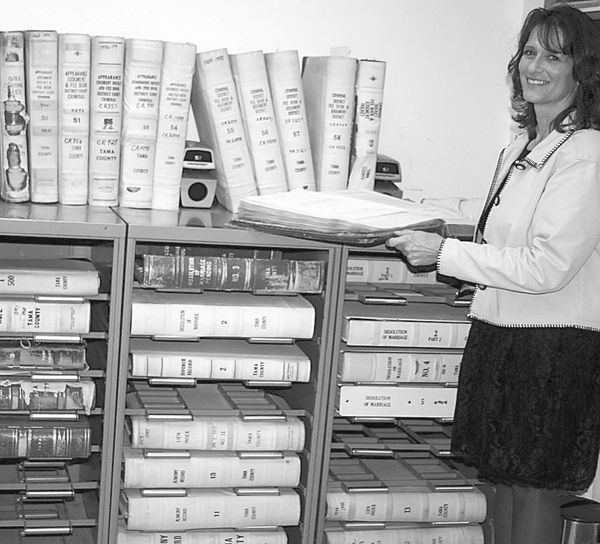
Tama County Clerk of the District Court Connie Rohach shows some of the bound files in a vault area in her office on Friday, Nov. 14. Records stored on three floors of vaults will become a thing of the past on dec. 9 when the Tama County Court system goes paperless.
Soon to be gone is the addition of any more paper court record files in the office of the Tama County Clerk of the District Court.
The move to “paperless” – computer – records will go into effect on Dec. 9, Connie Rohach, Clerk of the District Court, said last week. Iowa courts have been making a gradual transition which has been underway county-by-county to what is formally termed the Electronic Document Management System.
All courts including District, Magistrate and Juvenile are included.
Online Iowa court records show the idea has been under study since at least 1999.
Currently 69 counties have completed the change over, five including Tama are in the process, with the remaining 25 scheduled to be done in 2015.
An open house to acquaint the public will be held on Tuesday, Dec. 2, from 9 a..m- noon at the Clerk’s Office in the Tama County Courthouse in Toledo.
Trainers who have been working with clerk’s office staff will be present to answer questions.
A series of workshops have been held recently. Among those receiving instruction have been attorneys, Department of Human Services employees, law enforcement and clerk’s office staff.
The Tama County Clerk of Court office is closed today (Wednesday, Nov. 19) for another training session.
The sessions have been conducted by the court trainers and clerks of court from other counties which have already implemented the paperless system, Rohach said.
The new system has added monitors and scanners in the Clerk’s Office itself which was already computer equipped.
Rohach said there is a new computer and scanner for public use located in the first floor hallway. This will allow for paper documents which are to be filed to scanned and entered into the system.
The clerk’s office staff will be available to assist those unfamiliar with use of the equipment , Rohach said.
Equipment has also been added in the attorney’s conference room.
In addition, for each District and Magistrate judge’s bench an “all-in-one” computer has been added.
Law enforcement agencies in the county have also had to upgrade their systems because tickets issued must be entered into the system by computer.
This has required some departments, including Toledo and Tama police, to purchase new computers for installation in the patrol cars.
The old bound records and files won’t be going away, however, Rohach said. Stored in three floors of vaults adjoining the Clerk’s office, The earliest records found are those of wills dated from 1852.
The records range from criminal cases to alimony records to mechanic’s lien records.
Some duties including issuance of marriage licenses and birth and death certificates have been transferred to other county offices with those records maintained in the office currently responsible for them.
The Clerk’s Office will be required to transfer some of the paper records into the electronic system, the active case files in particular, Rohach said.
Tama Co. courts soon to be “paperless”
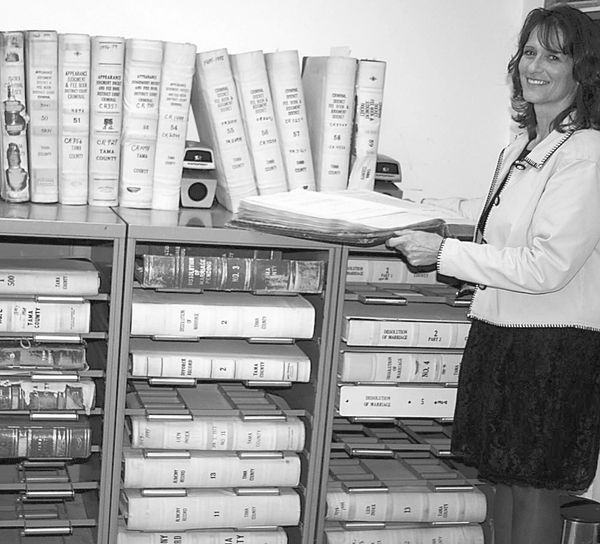
Tama County Clerk of the District Court Connie Rohach shows some of the bound files in a vault area in her office on Friday, Nov. 14. Records stored on three floors of vaults will become a thing of the past on dec. 9 when the Tama County Court system goes paperless.
Soon to be gone is the addition of any more paper court record files in the office of the Tama County Clerk of the District Court.
The move to “paperless” – computer – records will go into effect on Dec. 9, Connie Rohach, Clerk of the District Court, said last week. Iowa courts have been making a gradual transition which has been underway county-by-county to what is formally termed the Electronic Document Management System.
All courts including District, Magistrate and Juvenile are included.
Online Iowa court records show the idea has been under study since at least 1999.
Currently 69 counties have completed the change over, five including Tama are in the process, with the remaining 25 scheduled to be done in 2015.
An open house to acquaint the public will be held on Tuesday, Dec. 2, from 9 a..m- noon at the Clerk’s Office in the Tama County Courthouse in Toledo.
Trainers who have been working with clerk’s office staff will be present to answer questions.
A series of workshops have been held recently. Among those receiving instruction have been attorneys, Department of Human Services employees, law enforcement and clerk’s office staff.
The Tama County Clerk of Court office is closed today (Wednesday, Nov. 19) for another training session.
The sessions have been conducted by the court trainers and clerks of court from other counties which have already implemented the paperless system, Rohach said.
The new system has added monitors and scanners in the Clerk’s Office itself which was already computer equipped.
Rohach said there is a new computer and scanner for public use located in the first floor hallway. This will allow for paper documents which are to be filed to scanned and entered into the system.
The clerk’s office staff will be available to assist those unfamiliar with use of the equipment , Rohach said.
Equipment has also been added in the attorney’s conference room.
In addition, for each District and Magistrate judge’s bench an “all-in-one” computer has been added.
Law enforcement agencies in the county have also had to upgrade their systems because tickets issued must be entered into the system by computer.
This has required some departments, including Toledo and Tama police, to purchase new computers for installation in the patrol cars.
The old bound records and files won’t be going away, however, Rohach said. Stored in three floors of vaults adjoining the Clerk’s office, The earliest records found are those of wills dated from 1852.
The records range from criminal cases to alimony records to mechanic’s lien records.
Some duties including issuance of marriage licenses and birth and death certificates have been transferred to other county offices with those records maintained in the office currently responsible for them.
The Clerk’s Office will be required to transfer some of the paper records into the electronic system, the active case files in particular, Rohach said.
Local News
Werner shares her story during ‘Extension and 4-H Voices Day at the Capitol’

North Tama 2025-26 Honor Rolls

Ovens set to roar once again at Traer Pizza Palace

Supervisors announce 10% cut to public health budget, end to home health subsidies
Wilson appointed to North Tama school board vacancy