
Three things to know from North Tama school board
Facility plan, truancy issues discussed
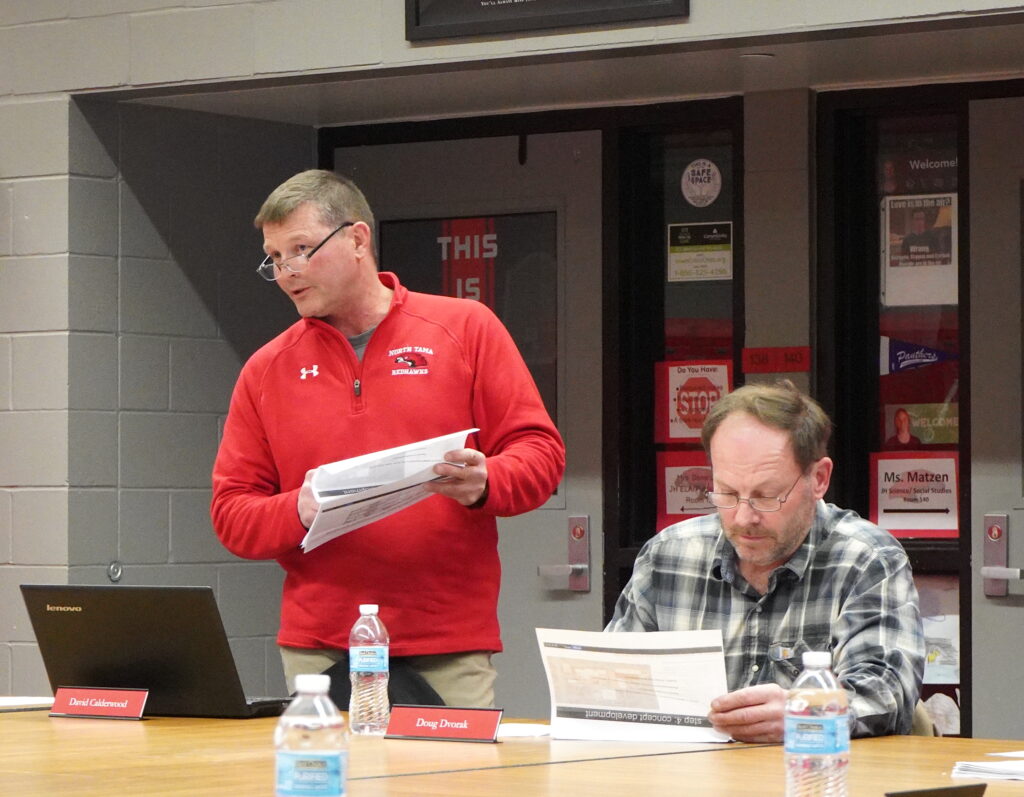
North Tama Board: North Tama Board of Education member David Calderwood (left) provides an update on the district’s facility study to members of the board including Doug Dvorak (right) during the regular meeting on Monday, Feb. 21 in the Junior High Commons. Photo by Soren M. Peterson
1. Facility plan update
As part of the regular meeting of the North Tama Board of Education on Monday, February 12, three members of the board including Haley Blaine, David Calderwood, and Doug Dvorak shared details following a facility study Zoom meeting they had the week prior between themselves, district administration, and representatives from both Align Architecture & Planning and Plunkett Raysich Architects. The purpose of the meeting was to narrow the three options the district was still considering for upgrading district facilities down to one option. Calderwood led the presentation to the board, highlighting three issues any facility upgrade would need to address including elementary space issues, the aging 1917 infrastructure/building, and the need for more gym space. The trio of board members settled on Option C – ruling out Options A and B – which would involve replacing the 1917 building, building a new two-story high school wing along with a new gym along the east side of the district’s block next to US Hwy 63, and renovating the elementary while also expanding into the 1917 building’s footprint. The plan going forward is to meet again with the architects and the financial firm Piper Sandler to flesh out the construction phasing, layout options, and financing options. While looking at the plans mapped out by the architecture firms, Superintendent Hill reminded the board the plans are not intended to be a floor plan but rather illustrative of the general direction the board wants to pursue. “Remember, that we are not in what’s called a design phase,” Hill said. “We’re very rough, we’re very big picture right now.”
2. Secondary truancy and graduation
As part of the Secondary Principal’s report, Principal Jeromiah Bliss shared with the board a troubling situation that has arisen among the high school population involving a large number of absences, tardies, and other attendance issues. Bliss highlighted the specific issue of some senior North Tama students possibly not being able to graduate this May because of time owed for unexcused absences. Per the handbook, North Tama students with more than eight absences for the semester in a class are placed in “credit forfeiture status” which means the student must make up the missing assignments and/or the time missed otherwise they may not receive credit for that particular class. In response to an inquiry from board member Blaine, Bliss indicated there are currently 12 or 13 junior and/or senior students in credit forfeiture status and of those, the seniors are at risk of not graduating. Per district policy, multiple forms of communication are sent home to each student’s parents/guardians in regards to truancy and/or credit forfeiture status. There are several ways to make up the time according to the handbook: before or after school with the teacher the time is owed, every Wednesday in the Junior High Commons from 2:30-4:00 p.m., any full day staff professional development day, and/or by prearranging assisting a school staff member with a project or task. The district has been following its truancy policy which can ultimately lead to action by the Tama County Attorney in extreme cases. As a result of the discussion, the board took a straw poll and unanimously affirmed their support for the handbook’s excessive absences policy and for Bliss to continue to enforce the policy as written.
3. Right of first refusal: 606 S Main Street
The right of first refusal agreement between the owner of 606 S Main Street, Kathryn Brady, and the North Tama County Community School District was approved by the board unanimously following Hill’s recommendation. The property is the last remaining section of the block that the school district does not own. The agreement gives the school district the first opportunity to purchase the property when the owners are ready to sell, in exchange for $100 from the district now. Such rights would follow the property.
Local News

IVH’s last WWII veteran passes away at 102
North Tama’s Thurston named to Statewide Broadband Council
IOWA – The Iowa Communications Network (ICN) has selected its next group of Iowa high school students to ...
Wolf Creek Players to hold fall auditions this Sunday
DYSART – The local theater group Wolf Creek Players recently announced auditions for its fall play, “The Many ...

25 years after 9/11, what disasters reveal about Americans’ ability to reconnect

Law enforcement leaders bring mental health, funding concerns to Sen. Grassley during Tama County meeting
Iowa PBS announces dates for Iowa Governor, U.S. House and Senate debates
IOWA – Iowa PBS will host televised debates for candidates running for Iowa governor, the U.S. Senate, and the ...