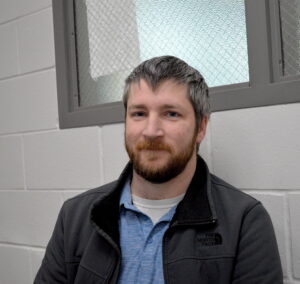
Sen. Sires helps introduce state constitutional amendment overturning Citizens United
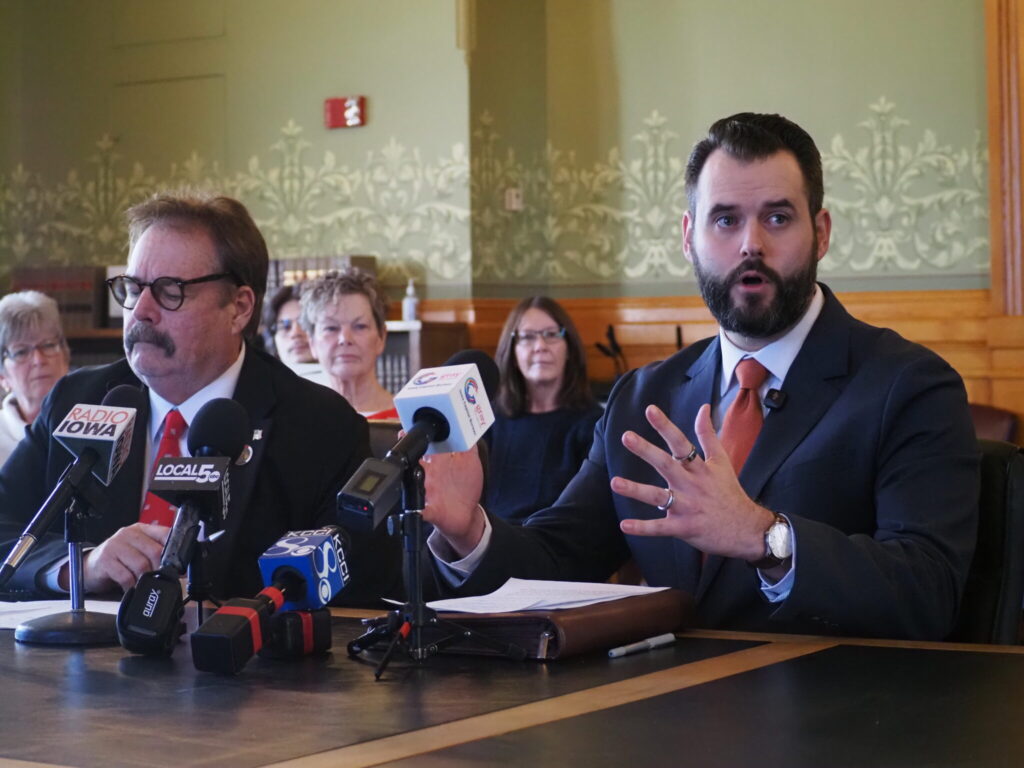
Sens. David Sires, left, and Zach Wahls held a news conference Jan. 21, 2026 about their proposal to add an amendment to the Iowa State Constitution aimed at limiting corporate political spending. Sires represents Iowa Senate District 38 which includes Dysart, Traer, and La Porte City. PHOTO BY ROBIN OPSAHL/IOWA CAPITAL DISPATCH
DES MOINES – Iowa Sens. David Sires (R-Cedar Falls) and Zach Wahls (D-Coralville) told reporters on Wednesday, Jan. 21, there is bipartisan interest in taking action to stop anonymous, corporate influence in Iowa elections.
The two senators introduced Senate Joint Resolution 2004, a proposed amendment to the state constitution saying “the people do not intend, and have never intended the powers and privileges of corporations to include participation in election activity, ballot-issue activity, or financial donations to political candidates or political committees.”
It would ban corporations from financially contributing or otherwise participating in election and ballot issue activities, with language specifying this does not stop businesses from being able to manufacture, operate or sell election equipment.
This proposal is specifically a means to combat the impacts of the 2010 U.S. Supreme Court decision in Citizens United v. Federal Election Commission, which struck down limits on how much money a corporation can directly spend in support of a political campaign.
Many critics of the decision have said Citizens United has given corporations and wealthy individuals the ability to fund elections without their identities publicized, as political action committees and candidates accept contributions from “dark money” groups — often 501(c)(4) social welfare groups or 501(c)(6) trade associations — which do not have to publicly release information about their donors.
Wahls, who is running for Iowa’s U.S. Senate seat in 2026, said in the 16 years since the Citizens United decision, “the floodgates opened, and it became easier for corporate interests and anonymous groups to spend unlimited amounts to influence our elections, often without voters even knowing who is behind it.”
He said the court decision has allowed special interests to set political agendas while the issues impacting most Iowans go unaddressed.
“This proposal is a state-based response to Citizens United and the idea that corporations should be able to spend unlimited money to influence our elections,” Wahls said. “The point is straightforward: Iowa’s democracy should belong to Iowans, not to corporate dark money and not to anonymous political spenders. I’m fighting for this because I believe the public’s business should be done in public, and because Iowans deserve a government that works for them, and when we reduce the corrupting influence of corporate money in our politics, we can create space to actually solve problems, lower costs and rebuild trust.”
Sires – a businessman and former Cedar Falls city council member who represents parts of Tama County, including Dysart and Traer – said there are many issues he and Wahls do not agree on, but that the proposed amendment was a bipartisan issue. He said polling shows “a majority of Americans in both parties want dark money out of politics,” and the amendment would address that issue in Iowa elections.
“This is a common sense issue and a conservative idea, that government should answer to citizens, not special interests,” Sires said. “Corporations receive special privileges from the state so they can operate in the marketplace, not to dominate in politics. The amendment is about Iowa’s independence and local control and making our election shaped by voters, not corporate money.”
The Iowa amendment language is similar to a proposed 2026 ballot measure in Montana, proposed by the group Transparent Election Initiative. In both proposals, corporations’ power granted through the state charter system would be limited for political campaign and candidate spending. However, states can only control the operation of corporations and businesses within their state.
“What we’re talking about here is corporations that are formed in the state of Iowa and their ability to spend those dollars on political activity,” Wahls said. “… We’re really trying to focus on corporations here in the state of Iowa, because that’s what we have jurisdiction over here in the General Assembly.”
While the proposal discussed Wednesday did not include any language encouraging Congress to overturn Citizens United at the federal level, both Wahls and Sires expressed interest in taking further action that would limit corporate influence and encourage transparency across all elections.
Sires said the measure is an important step in giving Iowans the ability to know where campaign funding is coming from.
“Democracy actually depends on informed voters, but when donors are hidden, citizens can’t evaluate who’s trying to influence them,” Sires said. “Anonymous influence allows powerful interests to shape outcomes without public accountability. … The issue isn’t just spending money, it’s spending money in secret. If you want influence an election, the public deserves to know who you are. Transparency is a small price to pay for democratic legitimacy.”
The proposal would have to gain approval in two consecutive general assemblies and then win approval from a simple majority of voters on a general election ballot before being added to the state constitution.
“It’s a lengthy process, but it needs to start somewhere,” Sires said.
Local News

Rex and Judy Raub inducted into Union Hall of Fame

That’s Cold

Traer ALA spreads Christmas cheer

Peoples Community Health Clinic to open this April in former MercyOne building
U.S. Senate candidate Zach Wahls makes campaign stop in Tama County