
Clutier Legion post spends Memorial Day morning saluting fallen comrades
- Legionnaire Lawrence Svoboda salutes after placing a flag on a veteran’s grave at Oneida Cemetery north of Clutier on Monday, May 25, 2026, as part of American Legion Hora-Machacek Post 453’s Memorial Day services. PHOTO BY DIANE CALOUD/CLUTIER LEGION AUXILIARY
- The American Legion Hora-Machacek Post 453 honor guard pictured at Holy Trinity Cemetery in rural Vining on Memorial Day, Monday, May 25, 2026. PHOTO BY DIANE CALOUD/CLUTIER LEGION AUXILIARY
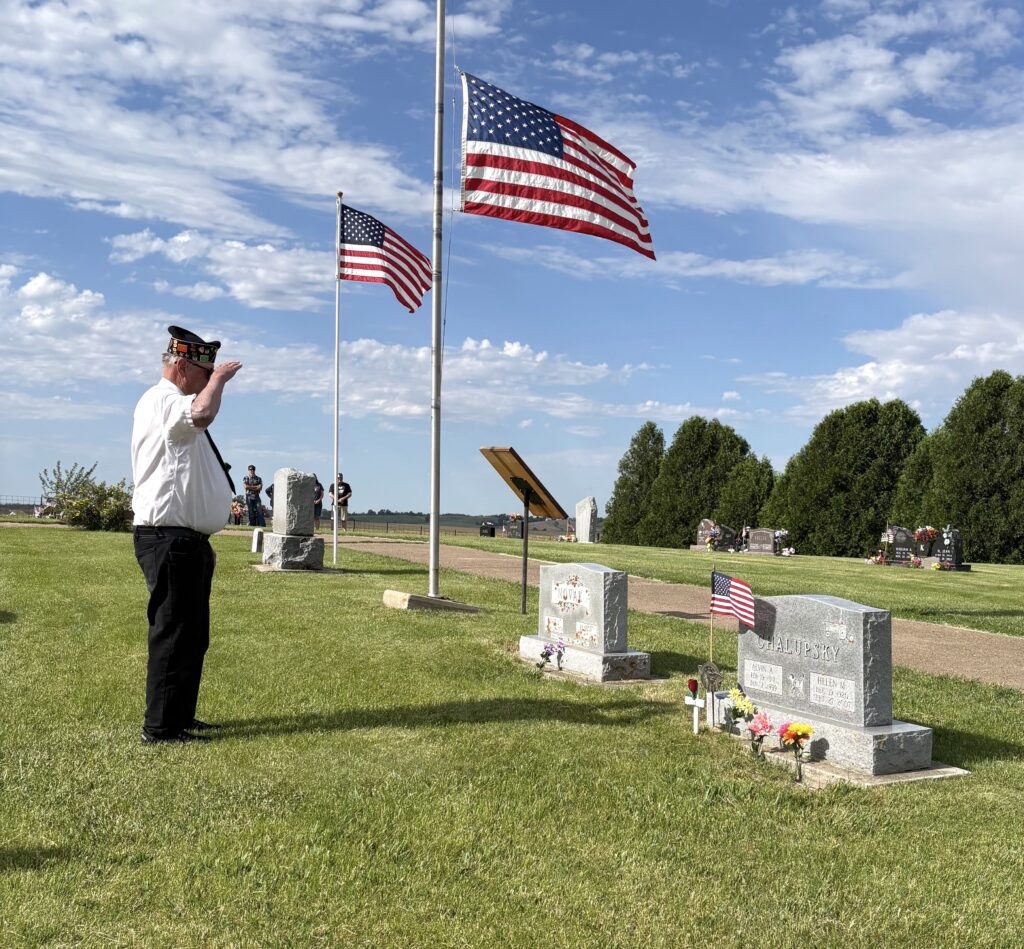
Legionnaire Lawrence Svoboda salutes after placing a flag on a veteran’s grave at Oneida Cemetery north of Clutier on Monday, May 25, 2026, as part of American Legion Hora-Machacek Post 453’s Memorial Day services. PHOTO BY DIANE CALOUD/CLUTIER LEGION AUXILIARY
CLUTIER — “Let us turn out and show,” said the Toledo Chronicle in 1878, “that we honor and revere the memory of those who have passed over to ‘Fame’s eternal Camping ground’ and joined ‘the bivouac of the dead.'”
In 2026, 250 years after the Declaration of Independence and 155 years since Decoration Day/Memorial Day ceremonies began in Tama County, veterans and non-veterans alike continue that honor.
“It’s a good day to remember our fallen comrades,” said Dave Svoboda on Monday, May 25, and indeed it was.
In 1871, three years after the first national Decoration Day, Tama County had its first ceremony at the courthouse in Toledo. There was an opening prayer, multiple addresses to the crowd, a procession to the cemetery, and a cannon fired three times.
Now, the occasion is often slimmed down, with a flag-raising, short readings, 21-gun salute, and a playing of taps. In many locations across Iowa, there are barely enough veterans able to be mustered up to carry out the task.
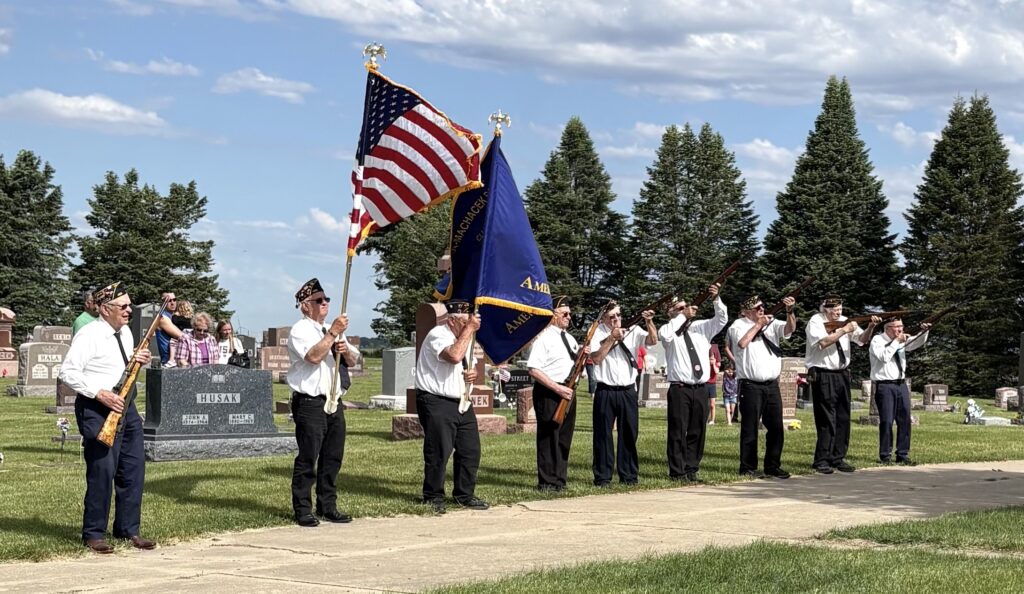
The American Legion Hora-Machacek Post 453 honor guard pictured at Holy Trinity Cemetery in rural Vining on Memorial Day, Monday, May 25, 2026. PHOTO BY DIANE CALOUD/CLUTIER LEGION AUXILIARY
Nine members of American Legion Hora-Machacek Post 453 — Harry Hlas, Duane Hosek, Bob Kroymann, Bernard Nachazel, Clair Svoboda, Dave Svoboda, and Butch Wiebbecke — and three members of the American Legion Auxiliary — Margaret Babinat, Diane Caloud, and Collette Wiebbecke — did Clutier’s Memorial Day tributes this year. They visited Clutier Cemetery, Oneida Cemetery, Holy Trinity Cemetery, St. Wenceslaus Cemetery, and National Cemetery near Vining.
“We don’t do it for us. We do it for the ones who aren’t here,” Kroymann said.
At each location, the attendance grew larger, from one family at Clutier Cemetery to dozens of people at National Cemetery. The last included a full ceremony with the national anthem, the Pledge of Allegiance, an invocation, descriptions of the symbols on the prisoners of war/missing in action table, readings of “In Flanders Fields” and “We Shall Keep the Faith” by Lauren and Kelsey Vavroch, and an address by Don Drahos of Grace Community Church in Belle Plaine. It ended with a picnic lunch.
“Please remember freedom is important,” Drahos said. “Honor those who have lost their lives defending the republic and become a part of the solution to the healing of America.”
The first appearance of “National Cemetery” in the Tama County archives is not for the one established here in 1887, but one with far more prominence.
“The ejectment suit brought by Gen. G.W. Custis Lee, son of the late Gen. Robert E. Lee, in the U.S. Circuit Court of Virginia, brings to mind many interesting facts in regard to the estate,” the Chronicle printed from a news service May 23, 1878. “It consists of about 1,100 acres — 250 including the Mansion, being walled in and known as the National Cemetery. There were interred here during the war nearly 18,000 Union soldiers, about 350 Confederates, and about 4,000 contrabands. The remains of over 2,000 soldiers gathered on the field at Bull Run and on the route to the Rappahannock are placed under the monument of ‘The Unknown.’ Since the war, numbers of the bodies have been removed and at this time there remain in round numbers about 13,000 in the City of the Dead.'”
Whether at a National Cemetery on a gravel road in Iowa or Arlington National Cemetery across the river from Washington, D.C., Monday’s objective was the same. We remember those who left their homes, farms, and communities to fight for the freedom of not only the American people, but for peoples around the world, and made the ultimate sacrifice.
Jeff Morrison is the writer behind the website “Iowa Highway Ends.” He grew up in Traer and now lives in Cedar Rapids. A version of this column was originally published in the Between Two Rivers newsletter on Substack, betweentworivers.substack.com. It is republished here through the Iowa Writers’ Collaborative. Please consider subscribing to the collaborative at iowawriters.substack.com and the authors’ blogs to support their work.
Local News
Meet the Iowa House District 53 Candidates: Berleen Wobeter

Hora-Machacek Unit 453 holds sewing day

Tama County Tom Stompers to host family bingo night Nov. 14 at Tama Ballroom

Meet the Candidates: Iowa House District 53
The place to be was Clutier: American Legion, Auxiliary host tandem fundraisers
