Area downtowns under the microscope
Deteriorating infrastructure, access to capital, turning community pride into economic momentum top ‘Downtown Assessment’ concerns in Traer, Dysart
- PHOTO BY RUBY F. MCALLISTER
- PHOTO BY RUBY F. MCALLISTER
- Professionals with the Iowa Economic Development Authority participate in a walkthrough of Traer’s downtown on Wednesday, Nov. 18, as part of the Iowa Downtown Resource Center’s Downtown Assessment program. Among the local leaders pictured are Traer Historical Museum President George Kadrmas (front left), Jared Bauch (center left), and Mayor Pro Tem Carri Holst (center right). Mayor Pete Holden is also present but obscured. PHOTO BY RUBY F. MCALLISTER
- Dysart Mayor Tim Glenn, right, speaks with a professional from the Iowa Economic Development Authority as they participate in a tour of the downtown block on Wednesday, Nov. 18. PHOTO BY RUBY F. MCALLISTER
- Dysart Chamber of Commerce President Nicole Taylor, far left, leads a walkthrough of Dysart’s downtown block on Wednesday, Nov. 18. Among those pictured are Iowa Downtown Resource Center Director Jim Engle (fourth from left), Realtor Dave Wrage (back right), and Tama County Supervisor Heather Knebel (far right). PHOTO BY RUBY F. MCALLISTER
- PHOTO BY RUBY F. MCALLISTER
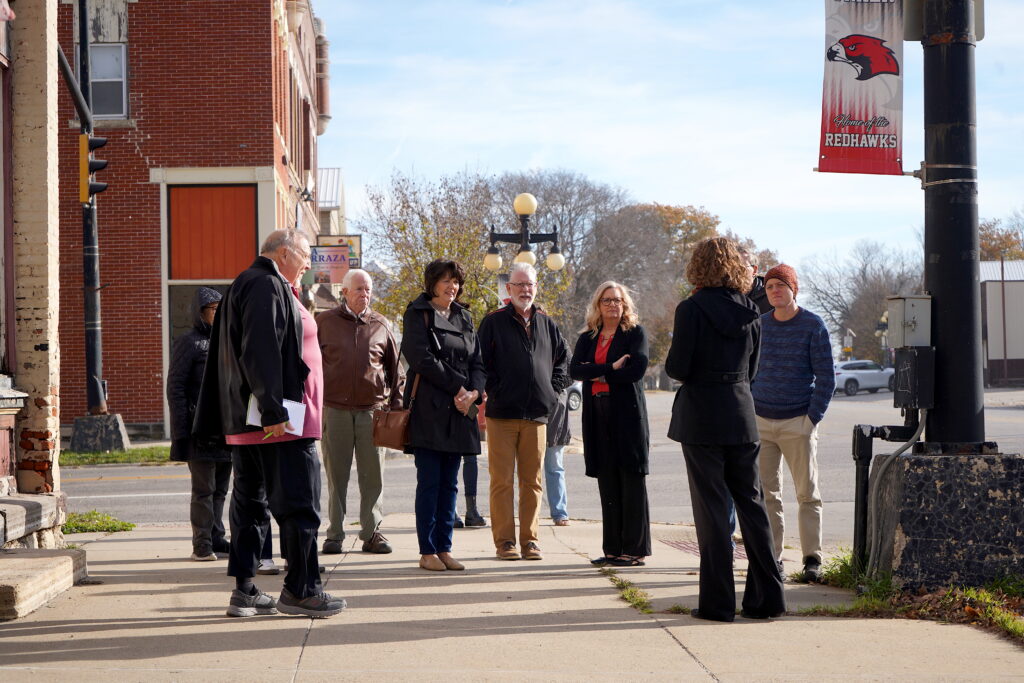
Professionals with the Iowa Economic Development Authority participate in a walkthrough of Traer’s downtown on Wednesday, Nov. 18, as part of the Iowa Downtown Resource Center’s Downtown Assessment program. Among the local leaders pictured are Traer Historical Museum President George Kadrmas (front left), Jared Bauch (center left), and Mayor Pro Tem Carri Holst (center right). Mayor Pete Holden is also present but obscured. PHOTO BY RUBY F. MCALLISTER
TRAER/DYSART – Five Tama County Main Streets took a turn under the microscope last week as part of the Iowa Downtown Resource Center’s Downtown Assessment program, including the communities of Traer and Dysart.
A group of professionals from the Iowa Economic Development Authority (IEDA), led by Downtown Resource Center Director Jim Engle, spent three days in the county. They visited Tama, Toledo and Gladbrook on Tuesday, Nov. 17, and then Traer and Dysart on Wednesday before holding a countywide presentation in Toledo on Thursday. As part of the assessment, each community underwent a downtown walkthrough and Q&A.
The Downtown Assessment facilitators began Wednesday morning bright and early in Traer, conducting a Q&A in the library’s small basement meeting room with some 20 members of the community, including Mayor Pete Holden, Mayor Pro Tem Carri Holst, City Clerk Haley Blaine, Tama County Supervisor Heather Knebel, North Tama Principal Taylor Howard, North Tama SBO Sara Forrester, and Traer Historical Museum President George Kadrmas plus several business/building owners and a few members of the public. Following the roughly hourlong Q&A, the four IEDA professionals walked both sides of Second Street’s downtown block, chatting with local leaders and business owners as they strolled.
The same scenario then played out in Dysart but in reverse order with the walkabout taking place first, led by Dysart Chamber of Commerce President Nicole Taylor, before the group moved to the community building for a catered lunch by KE Black Mercantile. After lunch, the roughly 90-minute Q&A took place. The Dysart Q&A was also well attended, garnering some 30 members of the local community, including downtown building/business owners. Mayor Tim Glenn and Supervisor Knebel both attended the Dysart walkthrough and the later Q&A.
Common themes
Dysart Chamber of Commerce President Nicole Taylor, far left, leads a walkthrough of Dysart’s downtown block on Wednesday, Nov. 18. Among those pictured are Iowa Downtown Resource Center Director Jim Engle (fourth from left), Realtor Dave Wrage (back right), and Tama County Supervisor Heather Knebel (far right). PHOTO BY RUBY F. MCALLISTER
As part of the Q&As, Director Engle and his team asked a series of similar questions in both Traer and Dysart geared toward identifying each community’s perceived strengths and challenges when it comes to their respective downtown areas. Several common themes emerged between the two communities.
In terms of challenges, both communities struggle with building revitalization, attracting and retaining downtown businesses, and turning community pride into long-term economic growth.
Specifically, Traer’s downtown area struggles with the high cost of renovating buildings, particularly the upper floors. But beyond just the vacant storefronts, many of the community’s downtown buildings are currently being used for storage and/or have street-level tenancy that has been “grandfathered” in by the city. “It looks like it’s hanging on by a thread,” one audience member characterized Traer’s downtown appearance.
In Dysart, several downtown buildings are also in disrepair — or even beyond repair, including this newspaper’s vacant former home which is owned by Marshalltown Newspapers. The high cost to purchase and subsequently rehabilitate deteriorating buildings creates an obstacle for potential new business owners who often are unable to fund the renovations alongside the requisite startup costs, several members of the Dysart audience said on Wednesday.
Recruiting new businesses to downtown was another shared concern across the communities. One of the barriers brought up in Traer was a lack of small amenities for downtown workers, particularly over the lunch hour, as well as a dearth of suitable outdoor seating and shade, particularly in the summer months. Quality, affordable housing was also relayed as a concern.
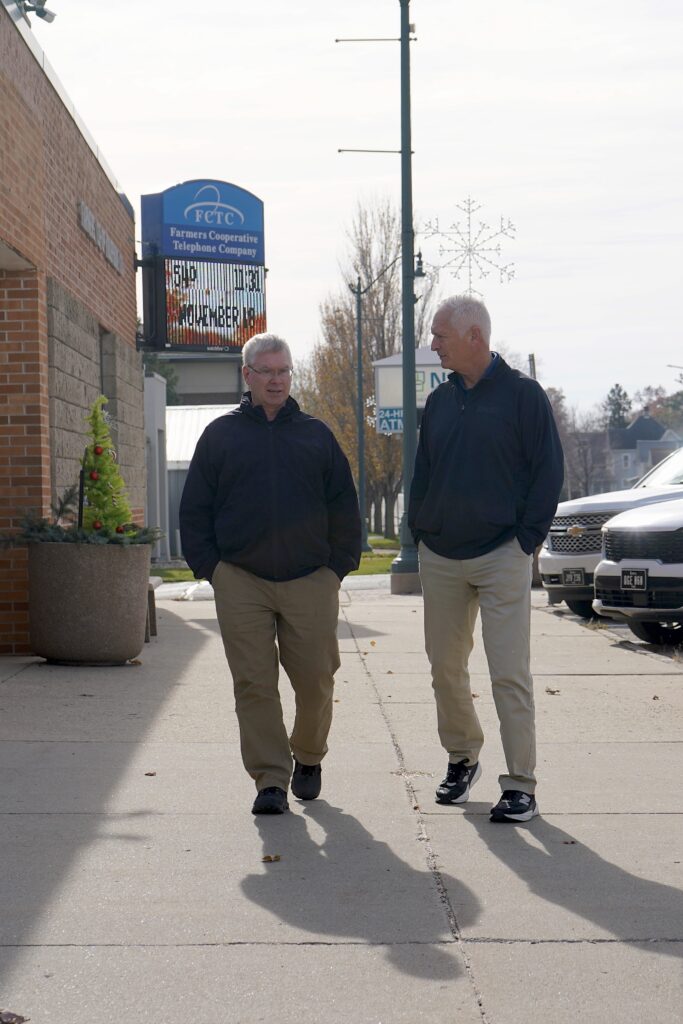
Dysart Mayor Tim Glenn, right, speaks with a professional from the Iowa Economic Development Authority as they participate in a tour of the downtown block on Wednesday, Nov. 18. PHOTO BY RUBY F. MCALLISTER
In Dysart, a more general lack of basic services was cited. The independent grocer Bobby’s Grocery & BBQ recently going out of business along with Sunnycrest Nursing Center closing in 2022 were both cited as examples. Dysart’s ability to attract customers from outside the immediate area was also concerning to those in attendance during the Q&A.
One of the most discussed challenges in both communities was how to turn strong community pride into sustained economic momentum. Traer and Dysart both hold several popular annual events and boast multiple community organizations and/or core groups of citizens invested in seeing the downtown thrive. Each community also proudly continues to retain a school attendance center (or two) despite stagnant or declining enrollment. But despite such strong local support, both communities are struggling to churn downtown traffic.
‘There’s no tax base in pocket parks’
“City governments get 75% of their money from property tax,” IEDA Downtown Economic Development Specialist Jim Thompson stated toward the end of Dysart’s Q&A on Wednesday while talking about a project his team undertook with the community of Ackley. “Here’s what happens when city governments won’t reinvest in a partnership with property owners: The buildings get torn down. And have you ever seen someone that crawled out from under a log that didn’t have all their teeth? That’s what your downtown will look like – and you’re really close to the edge of that right now. You’re going to have missing teeth.
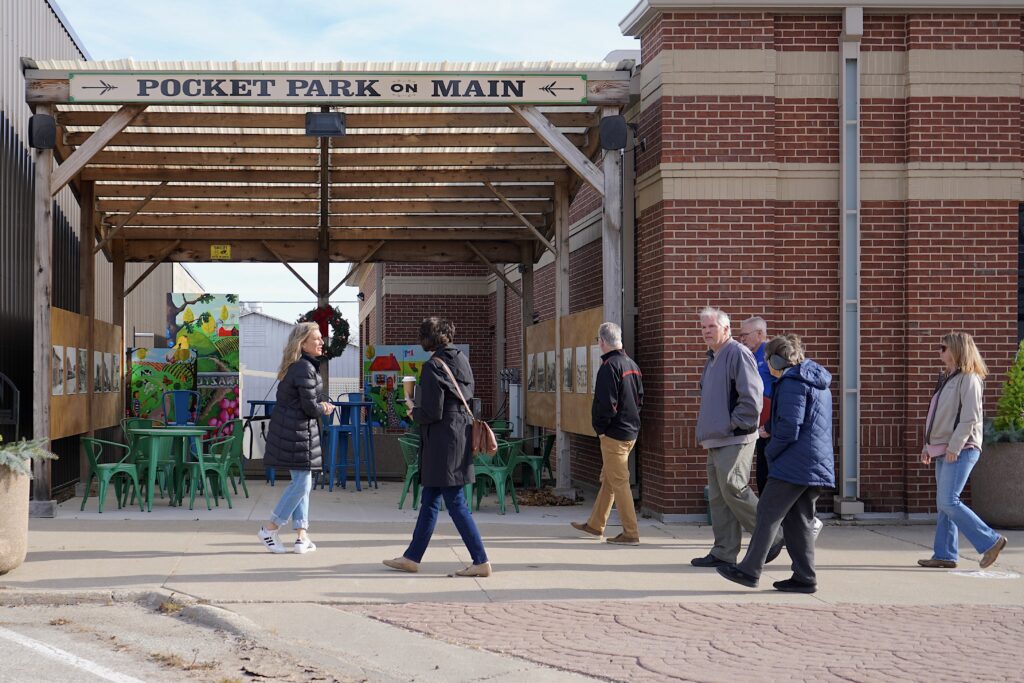
“I love your (Main Street) Pocket Park. You sure as hell don’t need another one,” he bluntly continued, drawing some chuckles from among the audience. “And, I’m sorry, there’s no tax base in pocket parks. So we’ve got to get smart about how we’re working with property owners to really make the reinvestment happen.”
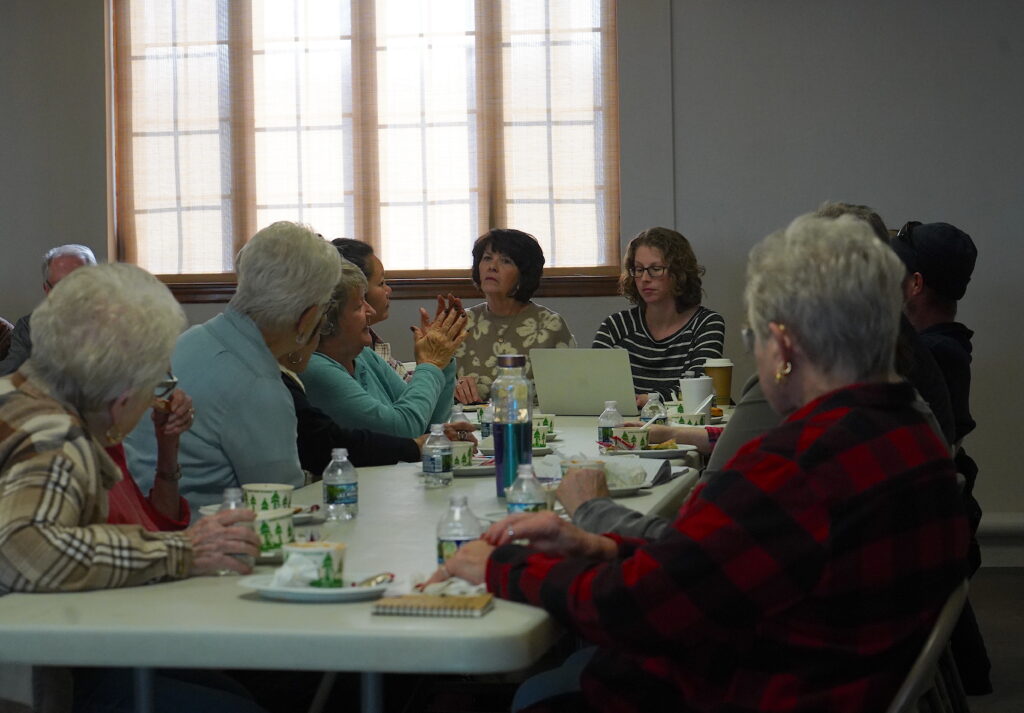
PHOTO BY RUBY F. MCALLISTER
He went on to say that if all a community wants to do is “tear buildings down,” then a Downtown Assessment is unnecessary.
“If that’s what you want, you don’t need me here. We can help you … But we’re really interested in you progressing, not regressing.”
What to do?
On Thursday afternoon, Nov. 19, the IEDA professionals gave a presentation at the Wieting Theater in Toledo where they were scheduled to discuss common issues from among the Tama County communities assessed as well as how those issues apply to each of the five respective communities.
A final report from the Tama County Downtown Assessment will be shared with the participating communities’ city councils, as well as the Board of Supervisors, in about four to six weeks. The facilitators recommended each of the five communities hold a subsequent community town hall to address the report’s findings and suggestions, including funding sources for revitalization.
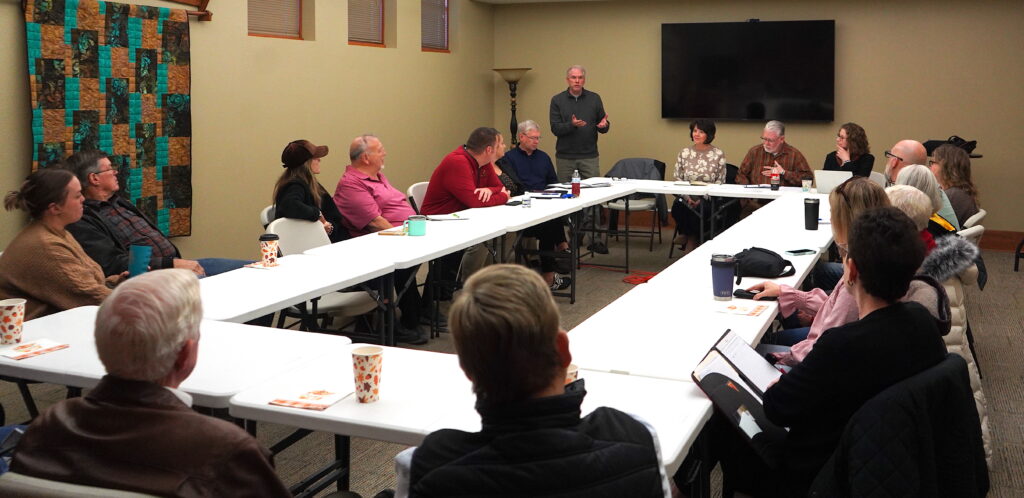
PHOTO BY RUBY F. MCALLISTER
“Then it’s really up to you,” one of the facilitators said as the Dysart Q&A drew to a close Wednesday afternoon. “We’d love to come back and help you – if you ask us. But once we deliver the report, it’s up to you all. We can’t force you to do any of what we’re going to suggest you do. That’s up to you and your community. But there’s a lot of experience sitting at this table and we have been working in a lot of communities all across the state and across the country. So, we’re not going to do everything perfectly, but there’s a lot of good experience that will be shared with your community. What you do with it is up to you.”
Local News
Union school board holds pair of meetings

U.S. House vote on contentious bill incenses veterans

Christmas on Main brings family fun to Dysart Dec. 5
La Porte-Dysart FFA greenhouse project awarded $25K grant
LA PORTE CITY – The Max & Helen Guernsey Charitable Foundation has awarded $25,000 to Union High School's ...
Dr. Pol to Keynote 2027 Iowa Pork Congress
DES MOINES – Iowa pork producers and industry professionals will come together Jan. 20–21, 2027, for the Iowa ...