
In the Sky: One Final Entry
- The Orion fountain. PHOTO BY DAVID VOIGTS
- The Orion constellation. PHOTO BY DAVID VOIGTS

David Voigts.
December will be a special month with the arrival in the evening sky of one of the best sights in astronomy – Orion (the Hunter), the brightest and most striking of all the large star patterns. He will rise in the east at about 8:00 as December begins and at about 6:00 by the end of the month. Most observers will first see the almost perfect three-star row of the Belt of Orion. No other compact naked-eye star grouping, or asterism, grabs our attention like these three stars.
A short distance below or south of the belt is another asterism of three dimmer stars in a row that represents the Sword of Orion. They are perhaps even more thrilling than the belt when viewed through binoculars or a telescope. When viewed this way, the middle star will be revealed as not a star at all, but the Orion Nebula. Nebulas are glowing clouds of gas and dust that, like this one, can be the birthplace of stars. There may be a thousand stars being formed within the Orion Nebula.
If that is not enough, this area is surrounded by a large box of four stars. To the left or upper left is the very bright reddish star Betelgeuse that represents Orion’s shoulder. Betelgeuse is a red supergiant star that is reaching the end of its life. To the right or lower right is the slightly brighter blue-white star Rigel that represents Orion’s knee or foot. It is a blue supergiant star that is hotter and more massive than Betelgeuse. Completing the box are somewhat dimmer stars, Bellatrix that represents Orion’s other shoulder and Saiph that represents his other knee. Orion’s raised sword, head, and shield are formed by dim stars.
In Greek mythology, Orion was a gigantic, supernaturally strong hunter. However, he was also an aggressive womanizer and very boastful, both of which raised the ire of the gods. According to one version of his myth, when he boasted that he would kill every animal, Hera decided he had gone too far, and she sent the tiny Scorpius (the Scorpion) to sting and slay him. Orion killed the scorpion, but after he was mortally stung. Zeus then placed them in opposite sides of the sky, so the enemies would never be in the sky at the same time. Orion was revived and continues to chase the Pleiades (or Seven Sisters) across the sky.
Although to many Orion is a moral lesson to not be boastful, he is revered in Messina, Sicily, as the founder of the city. According to legend, Orion smoothed the rugged coastline to make a harbor and land for the city. This feat is commemorated by a large fountain in the city square that depicts Orion and his hunting dog Sirius or Canis Major (the Great Dog).
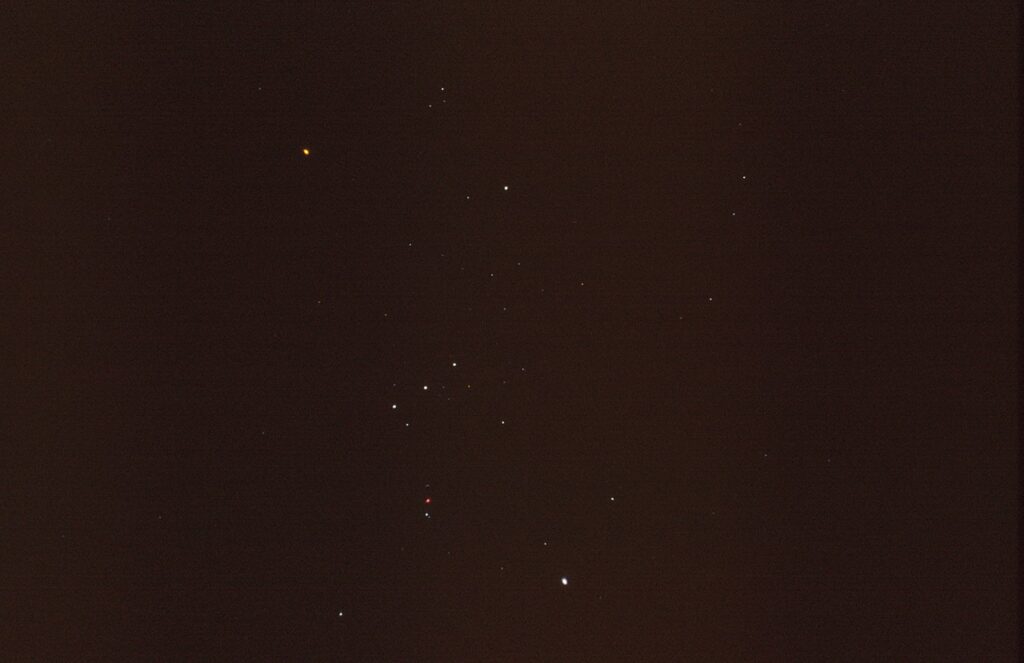
The Orion constellation. PHOTO BY DAVID VOIGTS
As I end this survey of some of the best sights in astronomy, it is a good time to end my monthly discussions of what is happening in the sky. It has been a joy to share this information over the years, but much of it is also available online, particularly at the free skyandtelescope.org and skymaps.com. Keep enjoying the night sky.
Observing Highlights
-Dec. 1: After they rise shortly after midnight and until they are overhead at dawn, very bright Jupiter, Regulus in Leo (the Lion), and reddish Mars will line up to the upper right of the Moon.
-Dec. 6: Brilliant Venus will be to the upper left of the crescent Moon and to the lower right of Spica, the brightest star in Virgo (the Maiden). Look about 60 minutes before sunrise.
-Dec. 13: The Geminid meteor shower, the year’s richest, will peak tonight with meteors seen all over the sky, but seeming to have come from near the bright twin stars in Gemini (the Twins). This shower has the advantage that meteors can be seen as early as 10:00, although up to 150 meteors an hour will be seen later under dark skies. Bundle up.
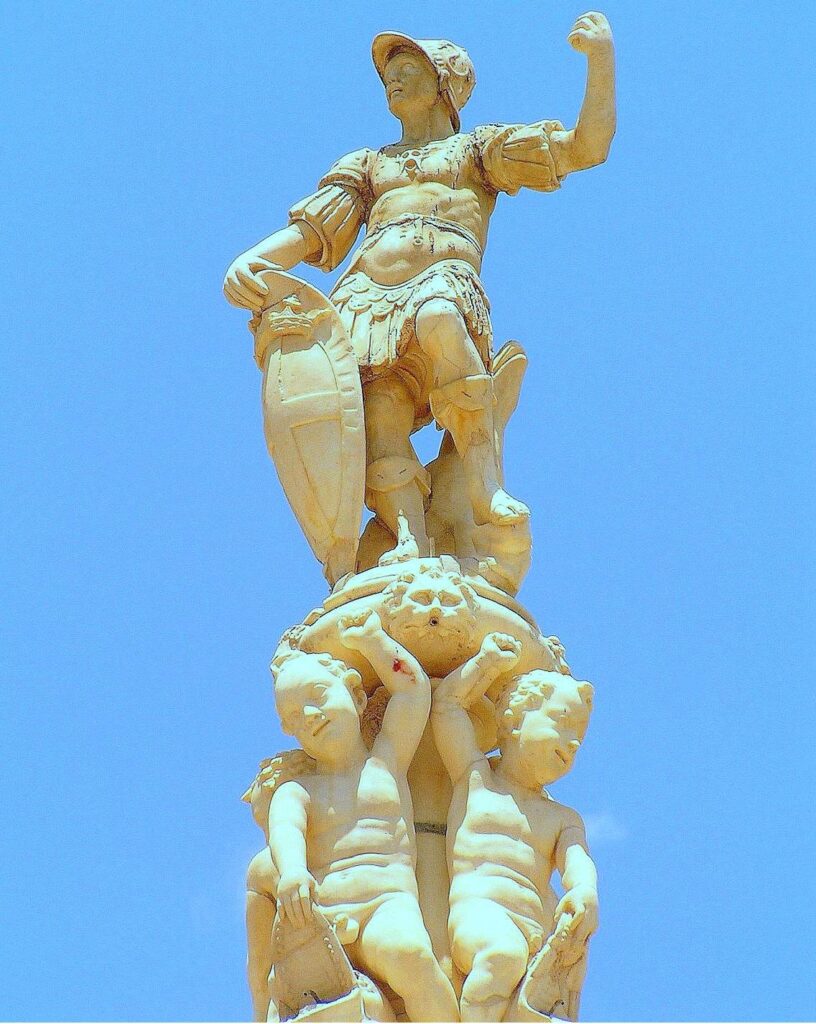
The Orion fountain. PHOTO BY DAVID VOIGTS
Dec. 17: The Moon will be to the upper right of Saturn in the southwestern sky and to Saturn’s upper left on the 18th.
Dec. 21: The day of the winter solstice that marks the year’s longest night of stargazing.
Dec. 28: After they rise at about 10:00, Jupiter and Regulus in Leo (the Lion) will again lead the Moon across the sky, but Mars will have moved eastward in its orbit and will now follow about an hour behind.
Local News

Union school board holds pair of meetings

U.S. House vote on contentious bill incenses veterans

Christmas on Main brings family fun to Dysart Dec. 5

Area downtowns under the microscope
La Porte-Dysart FFA greenhouse project awarded $25K grant
LA PORTE CITY – The Max & Helen Guernsey Charitable Foundation has awarded $25,000 to Union High School's ...
Dr. Pol to Keynote 2027 Iowa Pork Congress
DES MOINES – Iowa pork producers and industry professionals will come together Jan. 20–21, 2027, for the Iowa ...