
‘I fell in love with it. It caught my soul.’
Ahead of Earth Day, local conservationist Cathy Irvine presents program on prairies, land preservation
- Rural Dysart resident, retired teacher, and conservationist Cathy Irvine speaks during Dysart Historical Society’s annual meeting Sunday, April 19, at the Agricultural Museum in Dysart. A photograph of Cathy’s late husband, David Irvine Jr., is visible on the presentation screen behind her. PHOTO BY RUBY F. MCALLISTER
- PHOTO BY RUBY F. MCALLISTER
- PHOTO BY RUBY F. MCALLISTER
- PHOTO BY RUBY F. MCALLISTER
- PHOTO BY RUBY F. MCALLISTER
- PHOTO BY RUBY F. MCALLISTER
- PHOTO BY RUBY F. MCALLISTER
- PHOTO BY RUBY F. MCALLISTER
- PHOTO BY RUBY F. MCALLISTER
- PHOTO BY RUBY F. MCALLISTER
- PHOTO BY RUBY F. MCALLISTER
- PHOTO BY RUBY F. MCALLISTER
- PHOTO BY RUBY F. MCALLISTER
- PHOTO BY RUBY F. MCALLISTER
- NORTH TAMA TELEGRAPH FILE PHOTO/RUBY F. MCALLISTER
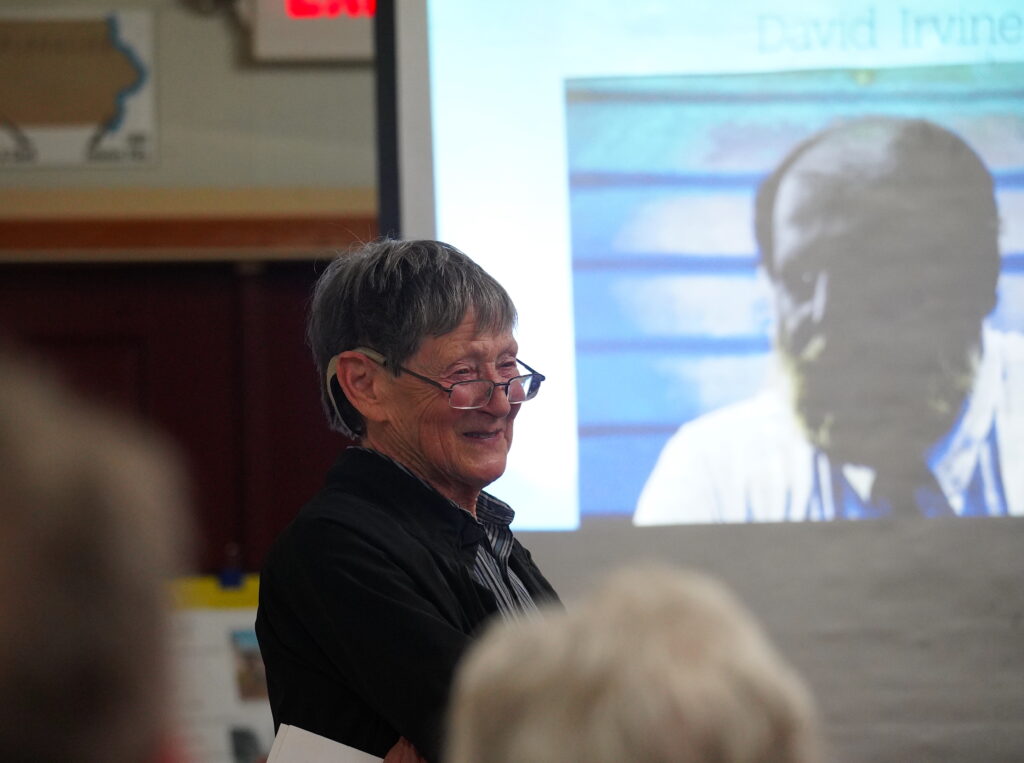
Rural Dysart resident, retired teacher, and conservationist Cathy Irvine speaks during Dysart Historical Society’s annual meeting Sunday, April 19, at the Agricultural Museum in Dysart. A photograph of Cathy’s late husband, David Irvine Jr., is visible on the presentation screen behind her. PHOTO BY RUBY F. MCALLISTER
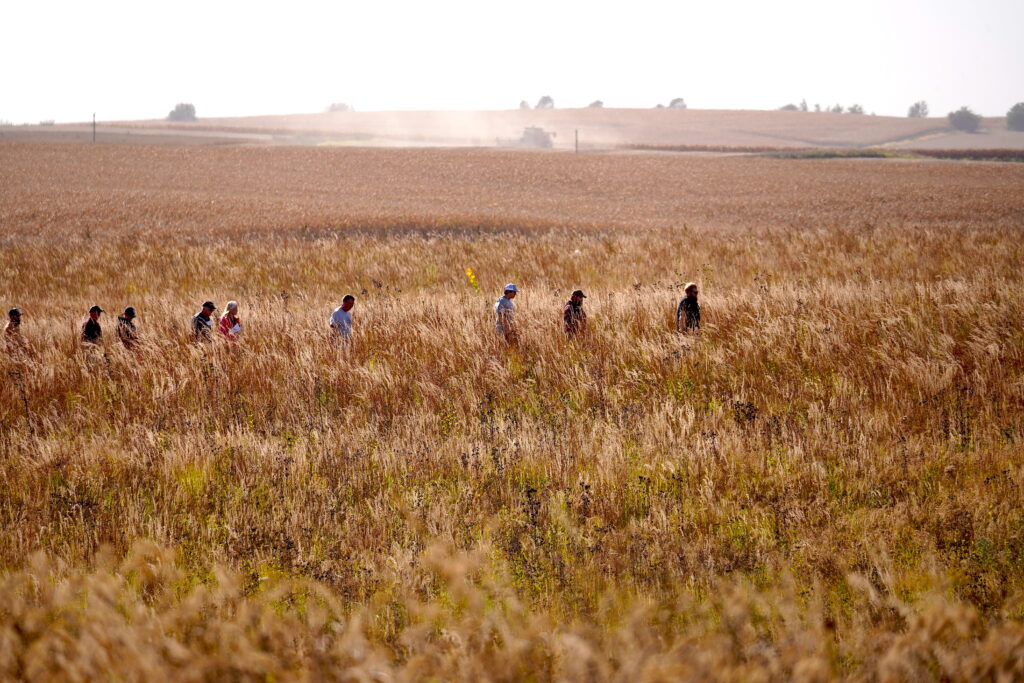
DYSART – While she may not be a “Dysart native,” retired educator Cathy Irvine has certainly blessed the community she has called home for most of her adult life with two incredible gifts – a pair of land donations, including the nearly 300-acre Irvine Prairie located roughly five miles northeast of Dysart as the crow flies and the two-acre Viola Irvine Nature Preserve located east of City Park.
Just ahead of Earth Day which was observed this past Wednesday (April 22) and Arbor Day which is celebrated today (April 24), Cathy was the featured speaker at the Dysart Historical Society’s annual meeting Sunday, April 19. Following the conclusion of official business, Cathy took the roughly 20 folks in attendance on a brief, but fascinating oral history of both gifts of land which have been in her late husband David Irvine’s maternal line for well over 100 years.
“I’m not a Dysart native, but I married one, and I lived here longer than I lived anywhere else, so I feel like I belong here,” Cathy said Sunday afternoon to begin. She then delved into the history of “Section 29 of Bruce Township” where both her home and Irvine Prairie are now located.
“This land that became Section 29 of Bruce Township … was granted to Morgan Reno in 1855,” she explained. “It wasn’t an easy start in farming, because Morgan Reno and 25 other people owned that land in the years between 1855 and and 1900. … In 1902, the farm and Section 29 were bought by David’s grandmother’s [uncle], John Drews. John Drews bought the farm and had it from that time on. … Drews and his wife Ella did not have children … [his land was left] to David’s grandmother because she was his sister. So she owned the farm. She and her husband never moved there. They rented it out.”
Following World War II, David’s father, David Irvine Sr., who served in the U.S. Navy, decided he no longer wanted to be a teacher in Gilman, Iowa, as he had been before the war.
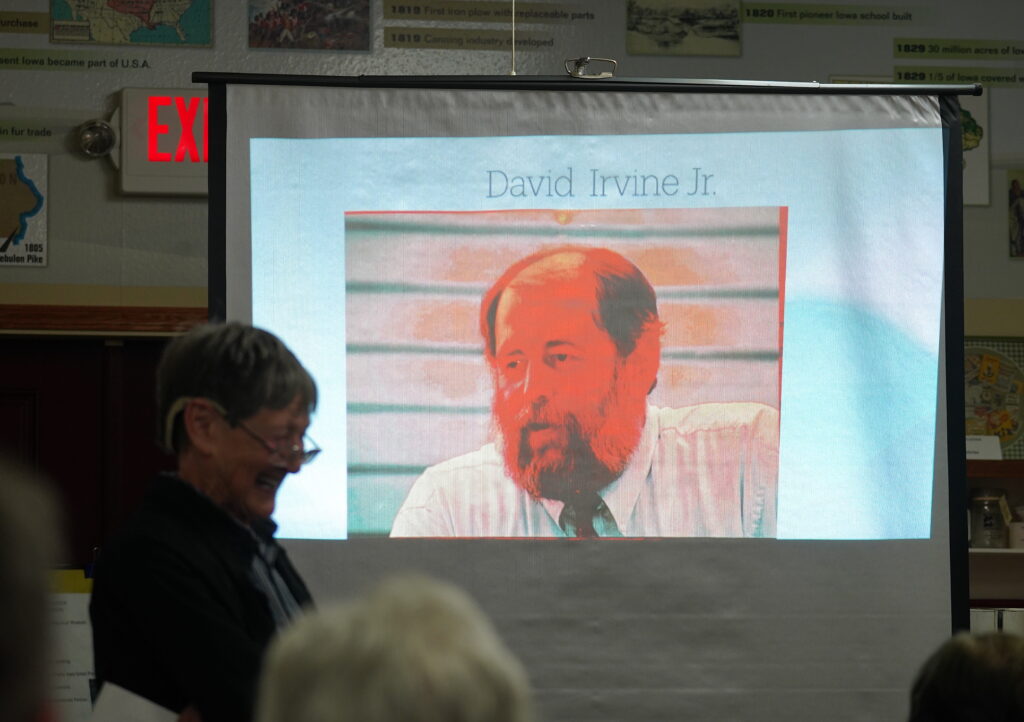
PHOTO BY RUBY F. MCALLISTER
“He decided he’d come home and farm his wife’s farm that she had inherited at the death of her parents,” Cathy explained. “They lived in town and drove out to the farm.”
By the time his parents, including his mother Viola Mehlhaus Irvine, stopped farming, David decided that, in a vein similar to his father, he no longer wanted to practice law.
“He wanted to farm,” Cathy said. “So we moved to the farm and lived in the little house that was there for the first few years of our marriage. We had no children and we read a book called ‘Where the Sky Began’ by John Madson. It was a book about Iowa history – which David loved; and Iowa farmland – which David loved. We loved the notion of prairies in Iowa and the history of Iowa as a place for prairies.”
Cathy then shared a story about prairies from her own heritage.
“I grew up hearing about my great-grandmother who lived in New Hampshire, and (how) they wore out the farms in New England,” she said. “After [my great-grandparents] were married … they wanted to start anew. So my great-grandfather and his brother walked from New Hampshire … [to] southwest Iowa. They found a place – a farm – where each brother would have a place to farm. And they built a barn because a barn will build a house, but a house will never build a barn. And so they started farming. … And when [my great-grandmother] got out of the wagon [in Iowa from New Hampshire] she looked around and she said, ‘This is the most beautiful prairie. I didn’t know it would be this pretty.'”

The Irvine Prairie pictured in warmer months. PHOTO COURTESY OF UNI STUDENT JACEY MEIER
“She didn’t say, ‘I had a horrible trip. Why did you do this? Why is there a barn and no house?’ She said, ‘This is the most beautiful thing I’ve ever seen.’ So I had that in my mind when [David and I] read the book (‘Where the Sky Began’).”
Cathy also attributed her love of prairie to visits she and David made beginning in the 1990s to Neal Smith National Wildlife Refuge in Prairie City near Des Moines.
“It was as beautiful as John Madson described it,” Cathy said. “There’s something magical about every place you can see (being) tallgrasses (and) bison. So that was extra special.”
Cathy said she also attended several events at UNI’s Tallgrass Prairie Center in Cedar Falls through the years, sparked by her and David’s interest in prairie.
“I didn’t think much more of it until 2016 when David died and I was left the farm to take care of. We didn’t have children. Family farms are getting scarce. It worried David that there wouldn’t be land for farmers – that somebody, some big farmer, would buy up all the land. You’d drive for miles and miles and never see a house. His (belief) was that Iowa farmers should be able to farm – and not 3,000 acres, but a family farm.”
NORTH TAMA TELEGRAPH FILE PHOTO/RUBY F. MCALLISTER
It was at that time, shortly after David’s death, that all the whispers of prairies past came together for Cathy and the idea to restore a prairie for the people of Dysart – and greater Iowa – moved to the forefront.
“My main thought was, ‘I need to protect what David loved,’ – (but) I didn’t know how I was going to do that. It took me about a year before I contacted [the Tallgrass Prairie Center] and talked to Dr. [Laura] Jackson. She didn’t know how it could be done (either), but we worked together.”
As part of the process, Cathy eventually donated her and David’s farm to the Iowa Natural Heritage Foundation which then placed the land in a permanent conservation easement.
“That way if the Tallgrass Prairie (Center) decided they didn’t want to take care of it – or couldn’t take care of it – it would not be broken up and sold as farmland. It has to be perpetually in the prairie,” Cathy explained. “[Then the Iowa Natural Heritage Foundation was] able to deed it to the University of Northern Iowa for the use and establishment of the prairie.”
After taking the audience on a tour of Irvine Prairie history, Cathy ended the segment with poignancy.

The Irvine Prairie located roughly five miles north of Dysart as the crow flies pictured on Friday, June 9, 2023. PHOTO BY RUBY F. MCALLISTER
“When I started the plan, I was trying to preserve the land. It was my last ditch effort. I needed to do something different. And so [turning it into] prairie was a rational decision. But after we had some of the land [restored to] prairie, I fell in love with it. It caught my soul, not just my rational thinking. It was beautiful. This is what we all need to know about. It became bigger than that decision that I had made. It became something that I believe in and want to share with everybody. So if you haven’t been there, do come. It’s lovely and I enjoy it. And I think you will, too.”
Viola Irvine Nature Preserve
As part of the second half of her roughly 45-minute presentation, Cathy explored the history of Viola Irvine Nature Preserve – an urban woodland located on the southeast side of Dysart behind 310 Sherman Street. The preserve was officially dedicated in April 2022 after years of work by both Cathy and the local tree board.
Cathy described how Joseph Dysart — a farmer, newspaper editor, state senator, and lieutenant governor for whom the town gets its name – received a grant of land in Dysart in 1855.
“I don’t even know how much land he got,” Cathy explained, “but it included most of that southeast corner of Dysart – what is now Dysart. … He never did move to that property there … and it was deeded and went to different people.”
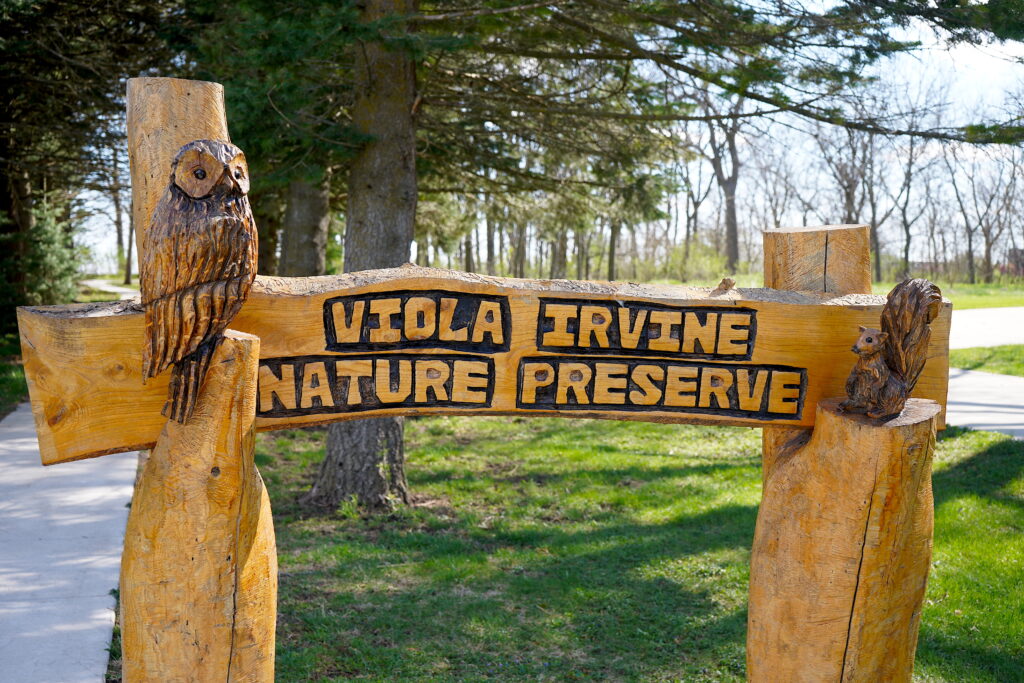
PHOTO BY RUBY F. MCALLISTER
Per past newspaper reporting, David’s great-grandfather purchased the property in 1904. Some 50 years later, David’s parents, David Sr. and Viola, bought it, replacing the old farmhouse that had been on the land with a newer prairie style home in the 1960s – a home Cathy still owns today.
“In 2020, after David died, I decided I needed to do something to keep that property from being sold [after I died] … and made it into a housing complex – or different housing there. So again, I wanted it to stay the way it was and the only thing I could think of was donating it.”
With the help of the Dysart Tree Board, Cathy again enlisted the expertise of the Iowa Natural Heritage Foundation to put in place a conservation easement before donating the parcel to the City of Dysart.
Cathy also talked about the many different birds she has either observed or heard throughout the preserve in spring months, including American Redstart, Warbling Vireo, American Robin, Rose-breasted Grosbeak, House Wren, Common Yellowthroat, Indigo Bunting, Northern Cardinal, and Brown Thrasher.
She further discussed the plethora of spring ephemerals that can be found in the woodland, including Virginia Bluebells, Virginia Waterleaf, Jacob’s Ladder, Jack-in-the-pulpit, Dutchman’s Breeches, Wood Poppy, Bloodroot, Wild Ginger, Mayapple, Spring Beauty, Hepatica, Rue Anemone, Trout Lily, Violet, Yellow Violet, Alumroot, Wild Phlox, Solomon’s Seal, and Wild Geranium.
“You have to get off the trail to see some of those,” she said of the flowers. “Right now you can see the Virginia bluebells and the wood poppies because they’re up and the grasses haven’t grown yet. So if you’re a flower enthusiast, those spring ephemerals will be around for a little while, but not too much longer.”
Cathy also shared news of a recent addition to the preserve — a little library.
“Last year at Christmas, my little brother gave us a Little Free Library and I thought it would be nice to have it right by the bench … on the pad there in the nature preserve. So I have put books in there. … and it’s ‘bring a book and take a book’. So feel free anytime.”
Before taking questions Sunday afternoon, Cathy once again touched on how preserving land for future generations has affected her.
“So again, the same thing happened with this project (as with Irvine Prairie). I started it to protect the land and not have it turn into a housing development – and it captured my heart. It’s been very rewarding for me to do both of those donations to the people of Dysart.”
In the final moments, a member of the audience who lives near Irvine Prairie spoke up with a comment.
“I just wanted to say that (Irvine Prairie) out there has become home to the wildlife, especially the pheasants. And in the wintertime, they come over to our farm and roost in the evergreens. It has really brought a lot more wildlife to the area,” the audience member shared.
In return, Cathy flashed a smile that seemed almost as broad as the prairie sky itself.
The Viola Irvine Nature Preserve can be accessed from Sherman Street in Dysart using the paved trail entrance located along the east border of the home at 310 Sherman Street or the unpaved trail entrance at the end of Maple Street east of Dysart City Park. Only street parking is available.
To visit UNI’s Irvine Prairie, navigate to 1174 55th Street, Dysart. The prairie is open to the public daily from sunrise to sunset. Visitors are asked to park on the south side of the road in the grass, near the stone marker. A portable bathroom facility is available from April through October. For more information visit https://tallgrassprairiecenter.org/irvine-prairie#visitorpolicy.
The Irvine Prairie is currently in the midst of hosting evening strolls with Cathy Irvine every fourth Monday of the month through September. Upcoming dates/programs include: April 27 (Where the Sky Began read-along begins); May 25 (birding walk); June 8 (read-along chapters 1-7); July 6 (read-along chapters 8-10); July 27(UNI biology and entomology professors); Aug. 24 (Benton County Conservation Monarch tagging); and Sept. 28 (Iowa Prairie Network).
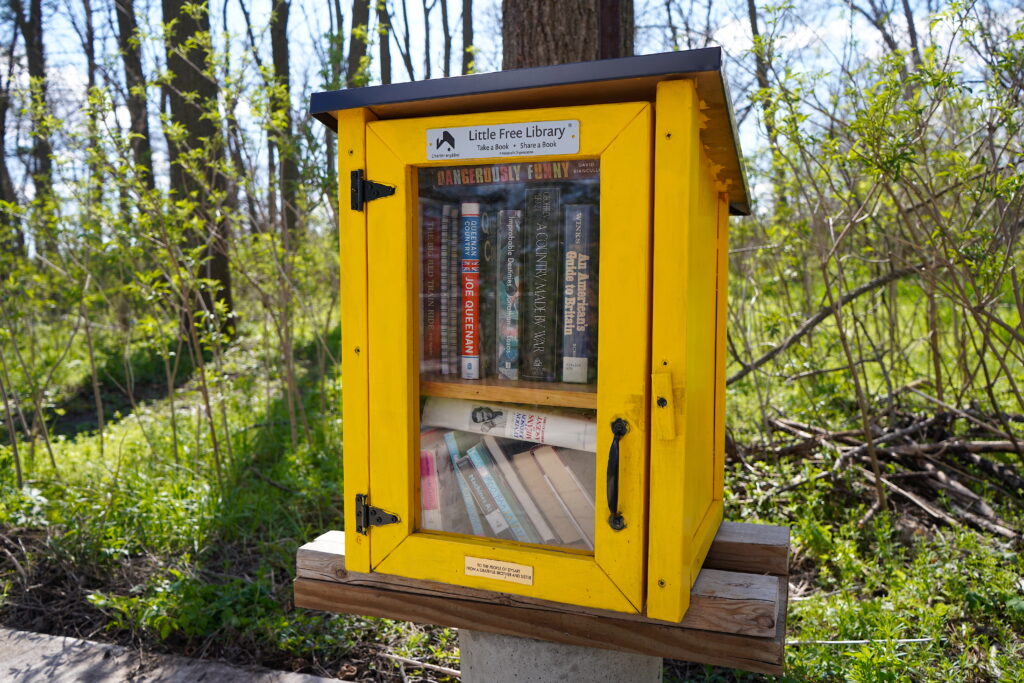
PHOTO BY RUBY F. MCALLISTER
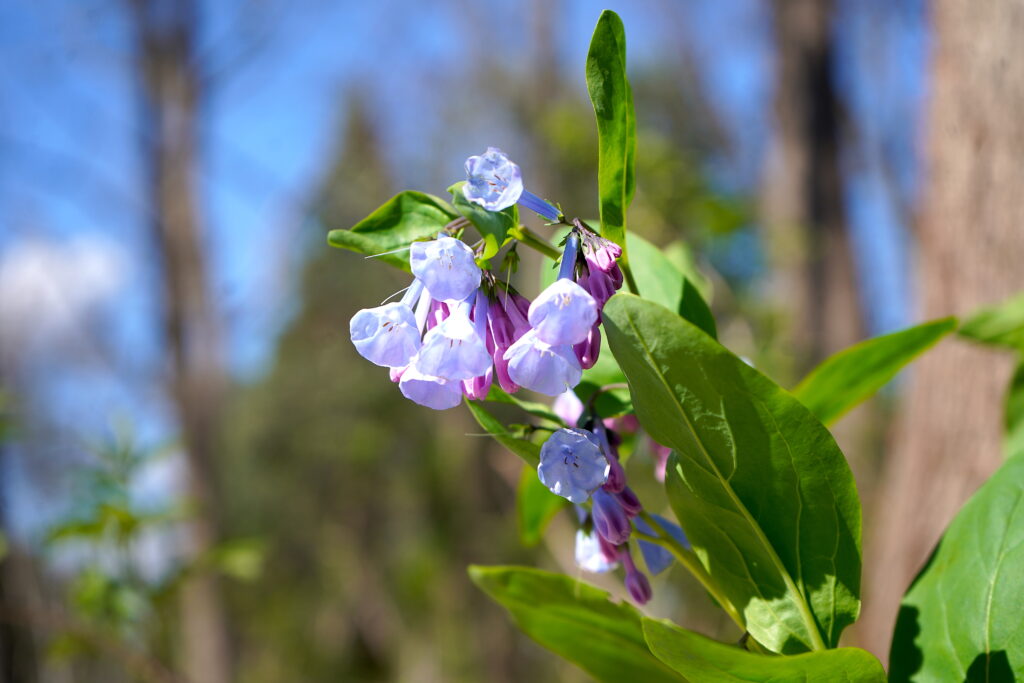
PHOTO BY RUBY F. MCALLISTER
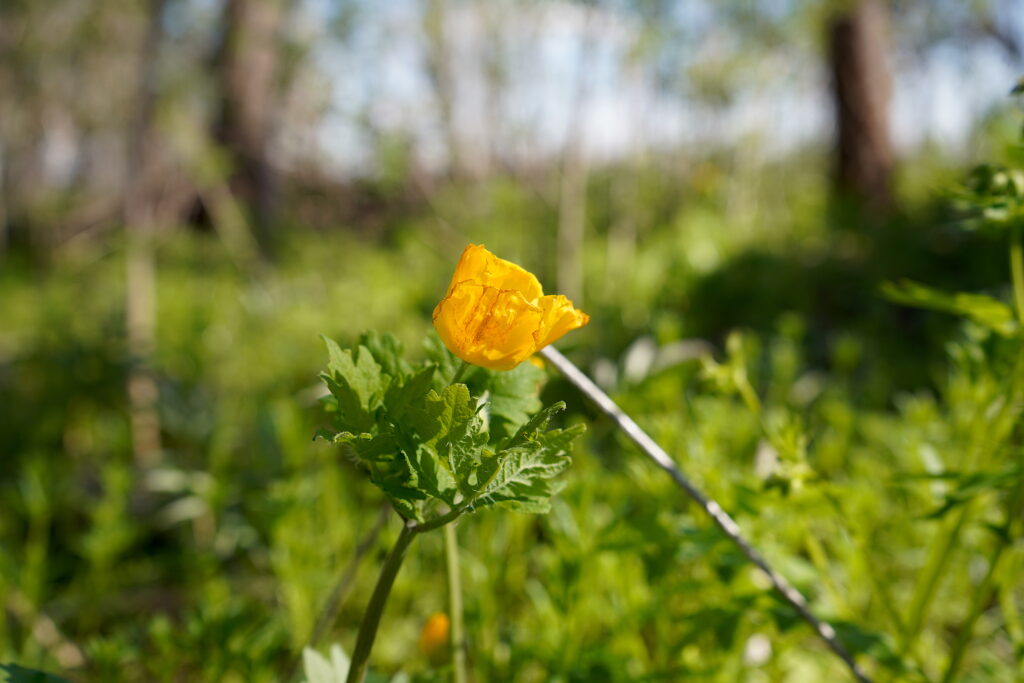
PHOTO BY RUBY F. MCALLISTER
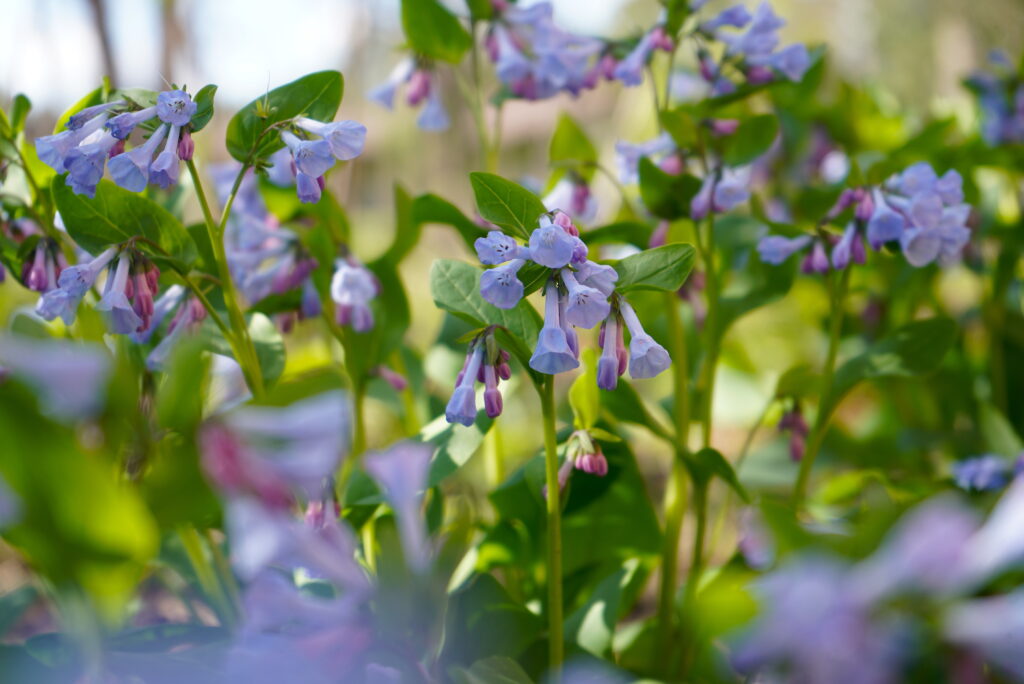
PHOTO BY RUBY F. MCALLISTER
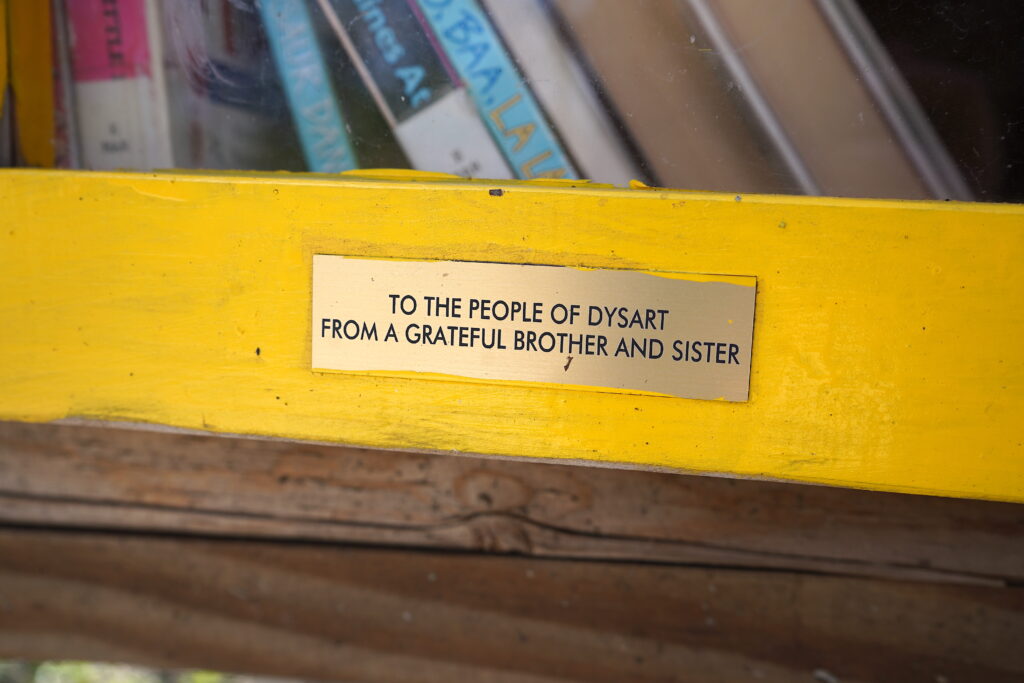
PHOTO BY RUBY F. MCALLISTER
Local News

IVH’s last WWII veteran passes away at 102
North Tama’s Thurston named to Statewide Broadband Council
IOWA – The Iowa Communications Network (ICN) has selected its next group of Iowa high school students to ...
Wolf Creek Players to hold fall auditions this Sunday
DYSART – The local theater group Wolf Creek Players recently announced auditions for its fall play, “The Many ...

25 years after 9/11, what disasters reveal about Americans’ ability to reconnect

Law enforcement leaders bring mental health, funding concerns to Sen. Grassley during Tama County meeting
Iowa PBS announces dates for Iowa Governor, U.S. House and Senate debates
IOWA – Iowa PBS will host televised debates for candidates running for Iowa governor, the U.S. Senate, and the ...