Dengler Domain: Egg Prices

Sean Dengler.
A little more than a year ago, egg prices were through the roof. Cartons of eggs were missing, and the avian bird flu was in full force. This had been an ongoing problem since 2022. After March 2025, egg prices dropped to lower prices, though still higher than pre-pandemic levels. Maybe the flocks regenerated quickly or something else was amiss.
According to the United States Department of Justice, it was not only the avian bird flu. The Iowa Capital Dispatch reports the largest egg producer, Cal-Maine Foods, and a couple other large producers, Hickman’s Egg Ranch, and Versova Holdings of Sioux Center, allegedly conspired to artificially inflate the price of eggs between 2022 and 2025. Everything below is also allegedly according to the United States Department of Justice. Using Urner Barry Publications, which reports market pricing for eggs based on the Egg Clearinghouse Inc. (ECI), they inflated the daily price quotations.
These quotations matter because the defendants’ contracts with retailers are based on these price quotations. When prices go higher, this means higher prices for consumers, but it also means more revenue and potentially more profit for the egg producers. When a “disaster” like the avian bird flu comes along, they have the perfect cover to bid up egg prices. According to the AP in 2025, “Cal-Maine reported a $219 million profit in the most recent quarter when its eggs sold for an average of $2.74 per dozen, up from just $1.2 million in the quarter just before this outbreak began in early 2022 when its eggs were selling for $1.37 per dozen.”
The magnificent profit expansion allegedly came when these companies submitted multiple bids to push up price quotations. According to the DOJ, “On the morning of October 14, a Cal-Maine executive texted Hickman’s CEO stating, “[w]e are bidding up. Let’s hold it today.” Later that day, Hickman’s CEO called a now-former Cal-Maine executive over the phone. By the end of the day, Hickman’s and Cal-Maine’s bids on ECI accounted for over half of the bids submitted that day.”
This was not the only way these companies influenced the process according to the DOJ. Urner Barry also tends to increase prices quotations if a variety of market participants are putting in higher bids. “Hickman’s CEO repeated his request early the following morning, on December 20, emailing senior executives from Cal-Maine, Versova, and others, stating, “[p]lease consider posting strong bids, early and often. The market reporters don’t get in for another hour, so it will be good for them to see diverse bidding upon logging on. Hickman’s CEO later emailed again, stating, “[h]urry[.] There are only 16 bids on ECI right now and 15 of them are ours [Hickman’s bids].” Shortly after that email, all three Defendants collectively submitted dozens of bids on ECI, most of which were at premium prices. By contrast, all other market participants combined submitted fewer than six bids that morning.”
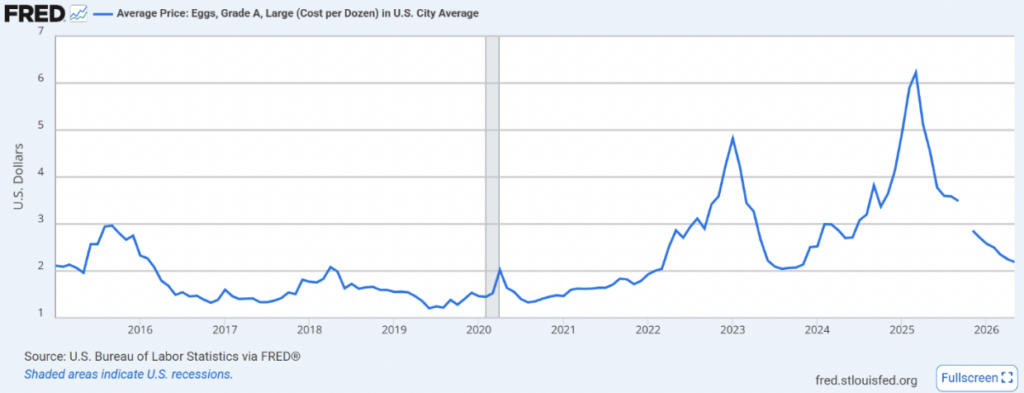
The big egg price drop in February 2025 occurred after these companies learned about a DOJ investigation into egg prices, and they were instructed to preserve documents on March 5, 2025, according to the DOJ. In a way, the government delivered lower egg prices for consumers by an implicit threat to stop allegedly unlawful price fixing.
What has come from this lawsuit is a series of proposed settlements which will prevent the companies from engaging in coordinated manipulation of egg prices according to the Iowa Capital Dispatch. It might not be the strongest settlement since they are required to build out their antitrust departments and monitor themselves, but something is better than nothing.
This is why breaking up these large companies and creating truly competitive markets which prevent alleged price fixing between large firms is valuable. Add in the part about more companies giving farmers more markets to sell into can lead to better revenue streams for farmers. This can keep more farmers on the farm, more people in rural communities, and a diversified farm revenue stream. More farmers with chickens can lead to less chickens per farmer because they can make more with less. Less poop concentrated in specific areas means potentially better water quality and leads to better outcomes for everyone besides those who currently hold much of the market power.
This is why spreading out economic power matters and not allowing consolidation into fewer hands. First came the egg, next comes the beef, but we already know what happens when the few holds too much power. Let’s create competitive markets again.
Sean Dengler is a writer, comedian, now-retired beginning farmer, and host of the Pandaring Talk podcast who grew up on a farm between Traer and Dysart. You can reach him at sean.h.dengler@gmail.com.
Local Columns

On Nature: Climate Predictions Happening

Dengler Domain: Northwest Iowa
Fall Is Here, But We’re Not Slowing Down
Dengler Domain: Rain Before Harvest
Dengler Domain: Taking Advantage